


Product Manuals
All Tableware
- Before first use, please wash with water or hot water.
- After each use, wash promptly, dry thoroughly, and store. Leaving it dirty may cause mold or stains, so please be careful.
- During use, crack-like patterns may appear on the surface; this is a glaze effect called “crazing” and is not an actual crack. It is perfectly safe to use.
- Avoid using dishwashers whenever possible, as they may cause chipping.
- While microwave-safe, this item cannot be used in oven settings.
- Small pinholes or black specks (iron particles) may appear on the surface, and variations in color may occur even within the same product due to firing conditions. Please understand these as characteristics of ceramic ware and enjoy the unique expression of each piece.
- Ceramics are very delicate. Please handle them with care. Although the bottom surface has been polished, we recommend using a mat or similar protection when placing the item on certain surfaces to prevent damage.
- If a product is broken, please dispose of it according to your local regulations.
Flower Vases
- This product is designed as a flower vase. Please do not use it for any other purpose.
- The Shigaraki-yaki clay used, made from natural materials, is characterized by its coarse texture and absorbency, which may occasionally cause moisture to seep from the bottom.
- While we inspect every item before shipping, unforeseen defects may occur. We recommend filling it with water before use to check for leaks, or placing it on a mat or similar surface as a precaution.
- When handling, please hold the entire piece with both hands.
- Small pinholes or black specks (iron particles) may appear on the surface, and variations in color may occur even within the same product due to firing conditions. Please understand this as a characteristic of pottery and enjoy the unique expression of each piece.
- During use, crack-like patterns may appear on the surface. This is a glaze phenomenon called “crazing” and is not an actual crack. It does not affect usability.
- Ceramics are very delicate. Please handle with care. Although the bottom is polished, use a mat or similar protection in case of accidental damage, depending on where you place the item.
- Dispose of broken products according to your local regulations.
Décor
- Please be careful not to swallow small parts or items.
- Keep out of reach of small children.
- To avoid damage, please hold the entire doll gently with both hands when handling it, as grasping small parts like the ears may cause breakage.
- Small pinholes or black specks (iron particles) may appear on the surface, and color variations may occur even within the same product due to firing conditions. Please understand this as a characteristic of ceramics and enjoy the unique expression of each piece.
- Ceramics are very delicate. Please handle with care.
- During use, crack-like patterns may appear on the surface. This is a glaze phenomenon called “crazing” and is not an actual crack. It does not affect usability.
- While the bottom is polished, we recommend using a mat or pad as a precaution depending on where you place the item.
- Exercise particular caution with heavy items regarding placement and handling.
- Dispose of broken products according to your local regulations.
Clay Rice Cooker
Your First Clay Pot: Start with Seasoning
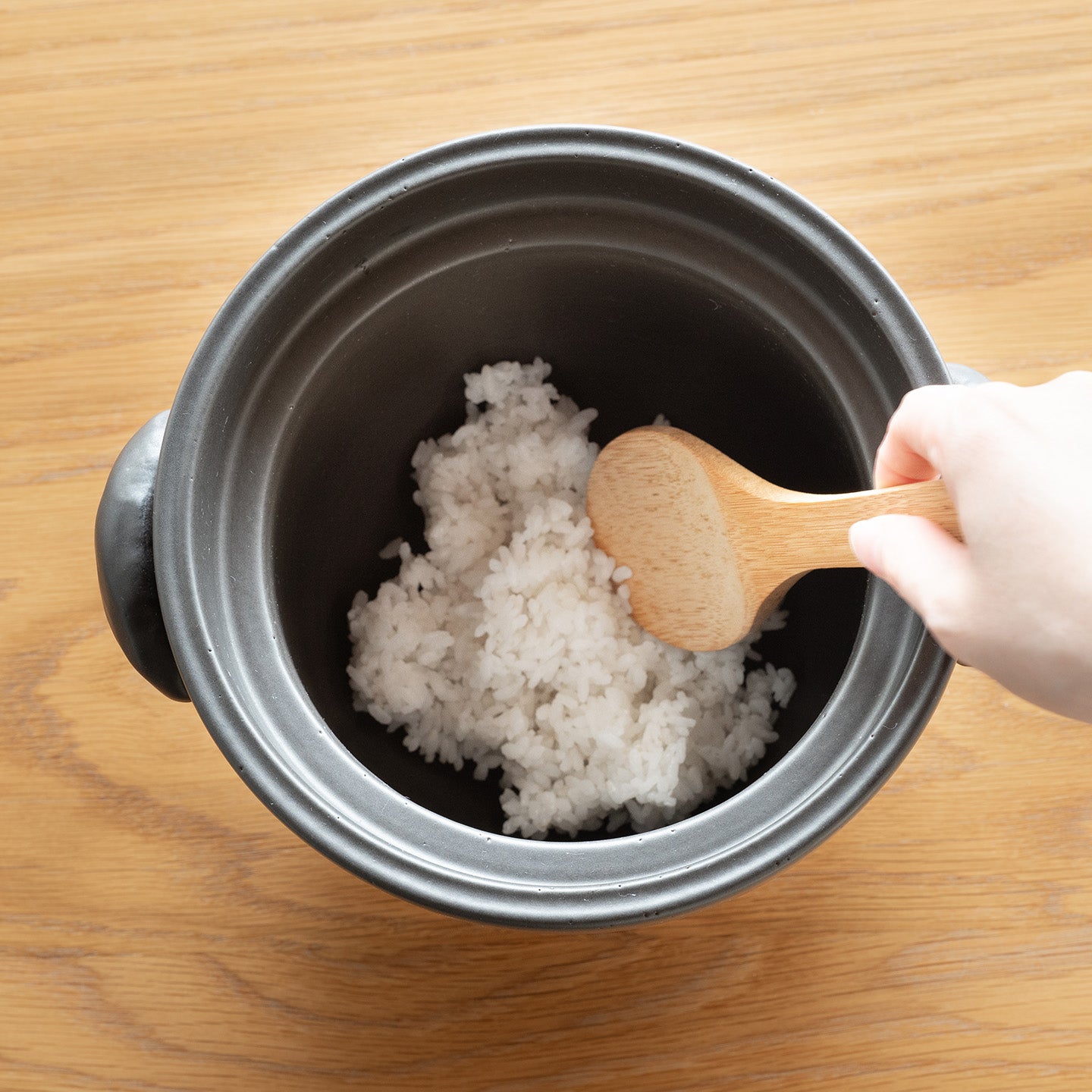
Before using your clay pot for the first time, perform a seasoning process. Seasoning involves cooking rice porridge to fill the tiny pores in the clay pot with rice starch. This prevents leaks and odor absorption, allowing you to use it safely and for a long time.

Sealing Procedure
- Thoroughly wash the clay pot with water, wipe off any moisture, and let it air dry upside down.
- Fill the dried pot about 80% full with water and add one rice bowl's worth of leftover rice.
- Simmer gently over low heat until the mixture thickens.
- Once cooked, turn off the heat. Allow the pot to cool completely before removing the porridge.
- Then wash the pot with water.
Even if it's your first time, you can relax—anyone can easily make delicious clay pot rice.
Cooking rice in a clay pot is actually very simple. No need to worry about heat control; you can easily enjoy fluffy, delicious clay pot rice. Follow the steps below to cook up fluffy, delicious rice.
Ingredients (for 2 rice cooker cups)
Clay pot: 4-cup or 2-cup size
Rice: 2 rice cooker cups
Water: 400ml Instructions
- Lightly rinse the rice, then drain it in a colander.
- Place 2 rice cooker cups of rice and approximately 400ml of water into the clay pot.
- Let it soak for 15 minutes. This allows the rice to absorb water thoroughly, resulting in a fluffy texture.
- Close the pot lid and cook on high heat for about 11 minutes. (For a 2-cup pot, use medium heat for 15 minutes.)
- When bubbles start popping and steam rises vigorously, it's boiling.
- Turn off the heat and let it steam undisturbed for 15 minutes. Steaming ensures the rice cooks evenly and becomes fluffy throughout.

*This cooking method is just one example. Results may vary depending on the type of rice (new crop, aged rice, brown rice, mixed grain rice, etc.) and the heat level of your stove. Please adjust the cooking time to achieve your preferred texture and discover your own perfect rice.
One of the greatest charms of pottery is how it develops a deeper character with use over time. As you use it for years, the surface texture and color may change—this is a unique characteristic of handmade pottery. Such aging is a testament to the time spent together, nurturing a one-of-a-kind personality.
We hope you will enjoy the charm of pottery as it accompanies your daily life.
About Cracks
Due to the nature of ceramic materials, fine cracks (crazing) may appear on the surface. These often occur due to sudden temperature changes or humidity, but they typically do not affect usability.
In fact, the crack patterns are considered to add a rich, characterful expression, enhancing the piece's charm.
However, if large cracks extend to the sides, discontinue use and consider replacing the item.

Regarding Scorching
Ceramic items may develop scorch marks on their surface when used over direct flame or due to heat control during cooking. While adjusting usage can prevent this scorching, if marks have already formed, try cleaning them with baking soda.
You may find yourself growing even more attached to your piece by viewing these scorch marks as a sign of well-loved use, part of the unique character inherent to ceramicware.

Chipping Of Edges and Corners
Ceramic items are vulnerable to impact, so dropping or bumping them may cause chipping.
While the chipped area may be visually noticeable, it is usually safe to use.
If there is a risk of injury to your hands during use, we recommend smoothing the area with sandpaper or replacing the item.

Let it dry thoroughly
After washing your earthenware pot, make sure to dry it thoroughly before storing. If moisture remains, it can cause mold and odors. Allowing it to air dry or gently heating it over low heat to dry the inside are both effective methods.
To enjoy your earthenware pot for many years, regular maintenance is essential. Please follow these points for regular maintenance.
Wash promptly after use
After cooking rice or other dishes, it's important to wash the clay pot as soon as possible. Washing it immediately prevents stains and odors from soaking into the pot's surface.
Use lukewarm water and a soft sponge to gently remove any residue. If you're concerned about grease, it's recommended to wash it using a small amount of neutral detergent.
Avoid using metal scrubbers or abrasive cleaners, as they can scratch the surface.
Make sure to dry it thoroughly
After washing your earthenware pot, make sure to dry it thoroughly before storing.
If moisture remains, it can cause mold and odors.
Allowing it to air dry or gently heating it over low heat to dry the inside are both effective methods.
Is sealing necessary for daily maintenance?
There is no need to season the pot during daily use. Seasoning is only necessary when using the pot for the first time, when cracks appear, or after prolonged periods of non-use.
It does not need to be done frequently.
point
If cracks or water leaks are visible on the bottom surface, performing maintenance by sealing the cracks will allow you to use it for a long time.
How do I remove stubborn burnt-on residue from my clay pot?
Avoid scrubbing too hard.
Try soaking it in lukewarm water for a while. This will soften the burnt residue, making it easier to remove.
If it still won't come off, boil it with baking soda for 10 to 15 minutes, then let it sit for a while before washing.
Why does the rice boil over when I cook it?
Boiling over is caused by excessive heat. Once it starts boiling and steam begins to rise, reducing the heat slightly is effective.
Also, using too much water makes boiling over more likely, so be sure to cook with an amount appropriate for the pot's capacity.
point
If the pot tends to boil over, slightly lift the lid to allow steam to escape while cooking, or wrap a damp, clean dishcloth around the lid's edge and vent holes to reduce boiling over.
Make sure to dry it thoroughly
After washing your earthenware pot, be sure to dry it thoroughly before storing it. If moisture remains, it can cause mold and odors.
Allowing it to air dry or gently heating it over low heat to dry the inside are both effective methods.
Pickling Jar
Ceramic pickling jars are characterized by their low heat conductivity and excellent heat retention, creating a stable environment ideal for microbial fermentation. They also offer the benefits of minimal chemical leaching and odor transfer.
Try making lots of delicious pickles!
- Before use, thoroughly wash with water or hot water.
- When carrying, hold firmly with both hands. Holding with one hand in an awkward position may cause breakage or damage.
- While dishwasher safe, hand washing is recommended to prolong the life of ceramic products.
- Also, avoid overfilling, as this can cause breakage.
Please use with care.
- Small pinholes or black specks (iron particles) may appear on the surface, and variations in color may occur even within the same product due to firing conditions. Please understand these as characteristics of ceramic ware and enjoy the unique expression of each piece.
- Ceramics are very delicate. Please handle with care. Although the bottom surface is polished, we recommend using a mat or similar protection when placing the item on certain surfaces to prevent damage.
- If a product is broken, please dispose of it according to your local regulations.
Make sure to dry it thoroughly.
After washing your earthenware pot, dry it completely before storing it. If moisture remains, it can cause mold and odors.
Allowing it to air dry or gently heating it over low heat to dry the inside are both effective methods.
Microwave Steamer
- The steaming bowl utilizes the absorbency of ceramic. When heated in the microwave, steam generated from the moisture within the bowl gently steams the ingredients, leaving them plump and tender.
- Before use, soak the bowl and lid in water for about one minute to absorb moisture.
- Since this product is designed to be used soaked in water, pre-seasoning is unnecessary.
- The heated steaming bowl becomes extremely hot. Always use pot holders or dishcloths.
- While dishwasher use is possible, hand washing is recommended to prolong the life of ceramic products.
- Also, avoid overfilling, as this can cause breakage.
- Avoid soaking. After washing, wipe with a soft, dry cloth, dry thoroughly, and store in a well-ventilated area.
- Clean as soon as possible after use. Leaving it for extended periods may cause odors to absorb. If odor persistence is a concern, try deodorizing with baking soda (sodium bicarbonate).
- Small pinholes or black specks (iron particles) may appear on the surface, and variations in color may occur even within the same product due to firing conditions. Please understand these as characteristics of ceramic ware and enjoy the unique expression of each piece.
- Ceramics are very delicate. Please handle them with care. Although the bottom surface has been polished, we recommend using a mat or similar protection when placing the item on certain surfaces to prevent damage.
- If a product is broken, please dispose of it according to your local regulations.